
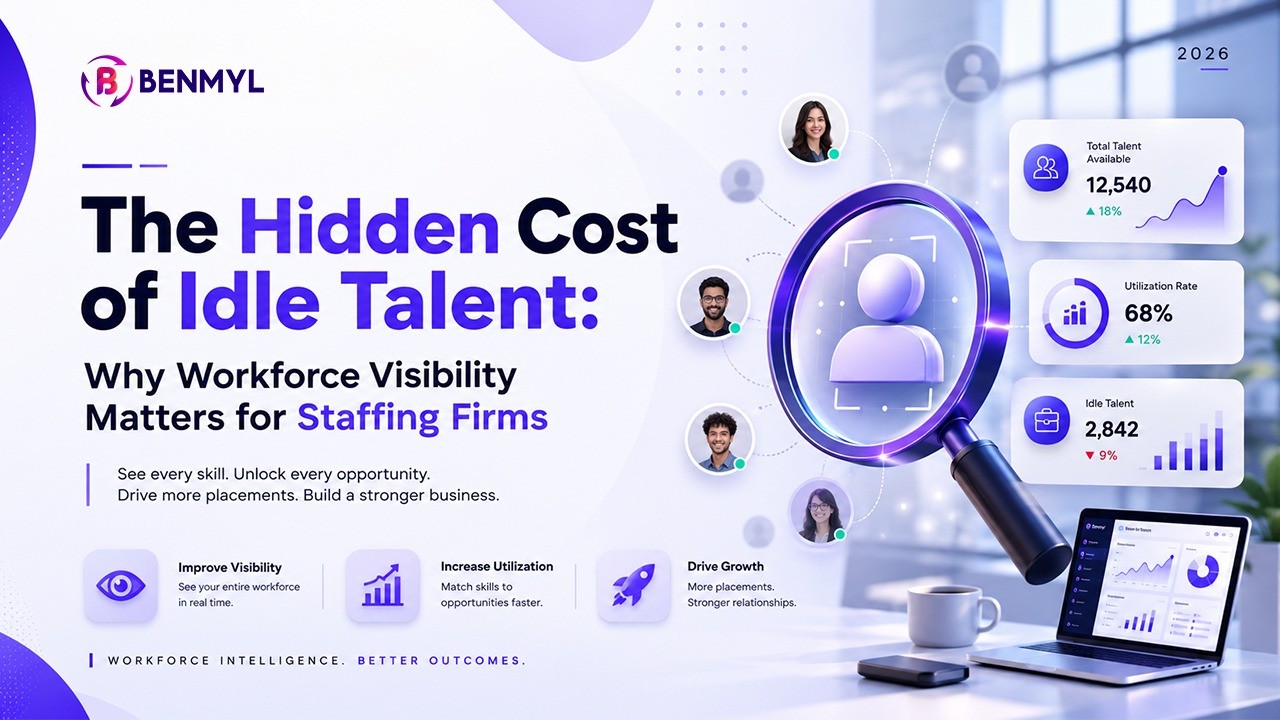
The Hidden Cost of
Idle Talent
Why traditional bench management is costing your staffing agency more than just payroll, and how predictive visibility protects revenue.
Executive Summary
Every unassigned day equates to permanent revenue loss that cannot be recovered.
Moving from reactive bench management to predictive workforce visibility is a strategic growth lever.
Modern staffing requires insights into future availability, not just present bench stats.
Every Day a Consultant Sits Unassigned, Revenue Potential Is Lost
For staffing firms, consultant availability is a normal part of business operations.
Projects end. Client priorities shift. New opportunities emerge. Consultants move between assignments.
The challenge isn't that consultants become available.
The challenge is how quickly organisations can identify opportunities and redeploy talent.
Many staffing firms have skilled professionals and potential opportunities available at the same time.
What they often lack is visibility.
Without clear workforce visibility, organisations struggle to identify available talent, forecast future capacity, and respond quickly to client needs.
As competition increases and project cycles become shorter, workforce visibility is becoming a strategic advantage rather than an operational requirement.
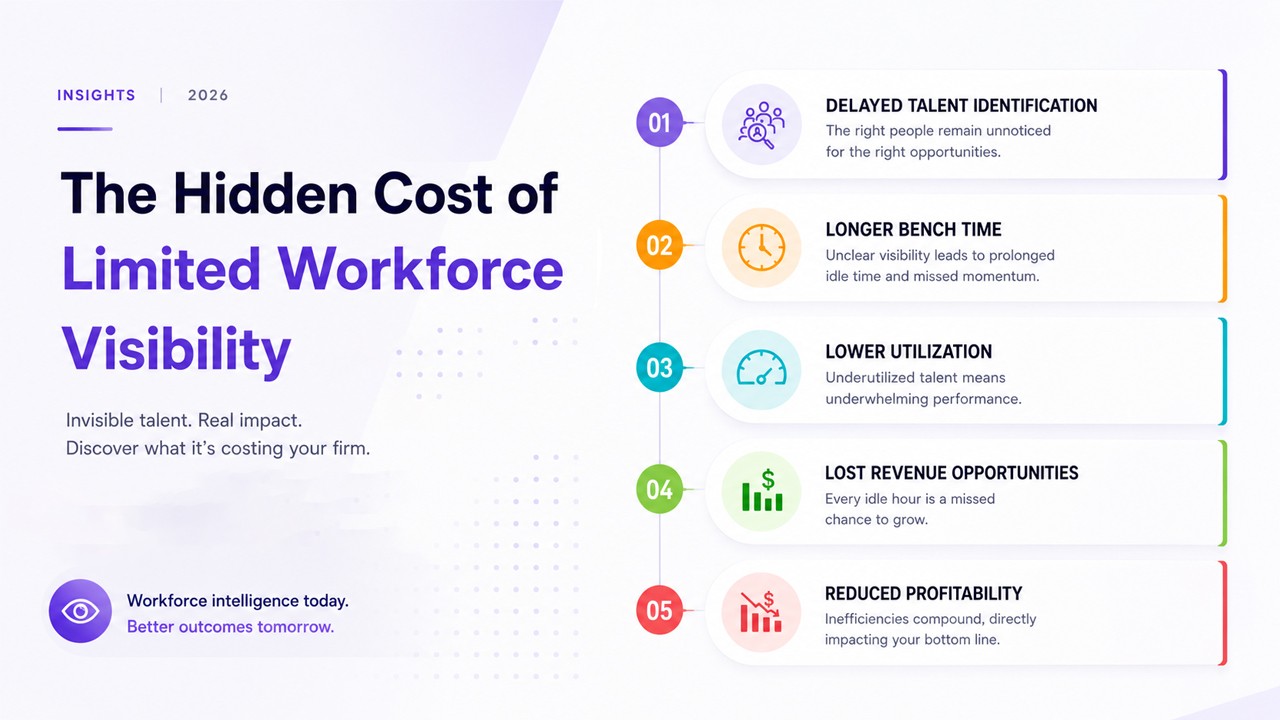
The Hidden Cost of Limited Workforce Visibility
Every Idle Consultant Is Revenue You'll Never Get Back
While most staffing leaders understand the direct cost of consultants remaining on the bench, the larger impact is often hidden.
When organisations cannot quickly identify available talent, opportunities can be delayed or lost entirely.
- Revenue pauses while operational costs continue.
- Utilisation declines.
- Forecasting becomes more difficult.
Over time, these small inefficiencies accumulate into significant business challenges.
Traditional Bench Management Is No Longer Enough
For years, staffing firms focused on a simple question:
"Who is available today?"
Today's workforce environment requires much deeper insight. Managing a bench list is no longer enough. Understanding workforce capacity is now critical.
The Shift from Bench Management to Workforce Visibility
Workforce visibility expands the focus beyond current availability. It provides a complete view of workforce capability and future capacity. Modern staffing leaders need visibility into future availability, project completion timelines, workforce demand, and skill distribution.
What Workforce Visibility Includes
Organisations with this visibility can make proactive decisions rather than reacting to staffing challenges after they occur. Instead of asking:
"Who is available right now?"
They begin asking:
- Which consultants become available next quarter?
- Where are utilization risks emerging?
- Which skills are in highest demand?
- How can we improve deployment speed?
This shift transforms workforce management into a strategic growth function.
From Bench to Revenue: A Real-World Example
Without Visibility
Consider a staffing firm with 75 consultants. A cloud engineer is scheduled to complete a project in two weeks.
The organization has potential opportunities, but skills, availability, and timelines are maintained across spreadsheets, emails, and disconnected systems.
When an urgent client request arrives, valuable time is spent identifying available talent. The client chooses a competitor.
With Visibility
The system proactively alerts managers that the cloud engineer is becoming available soon.
A matched opportunity is immediately identified based on skill requirements and timeline alignment.
The consultant is redeployed without a single day on the bench. Revenue is protected.
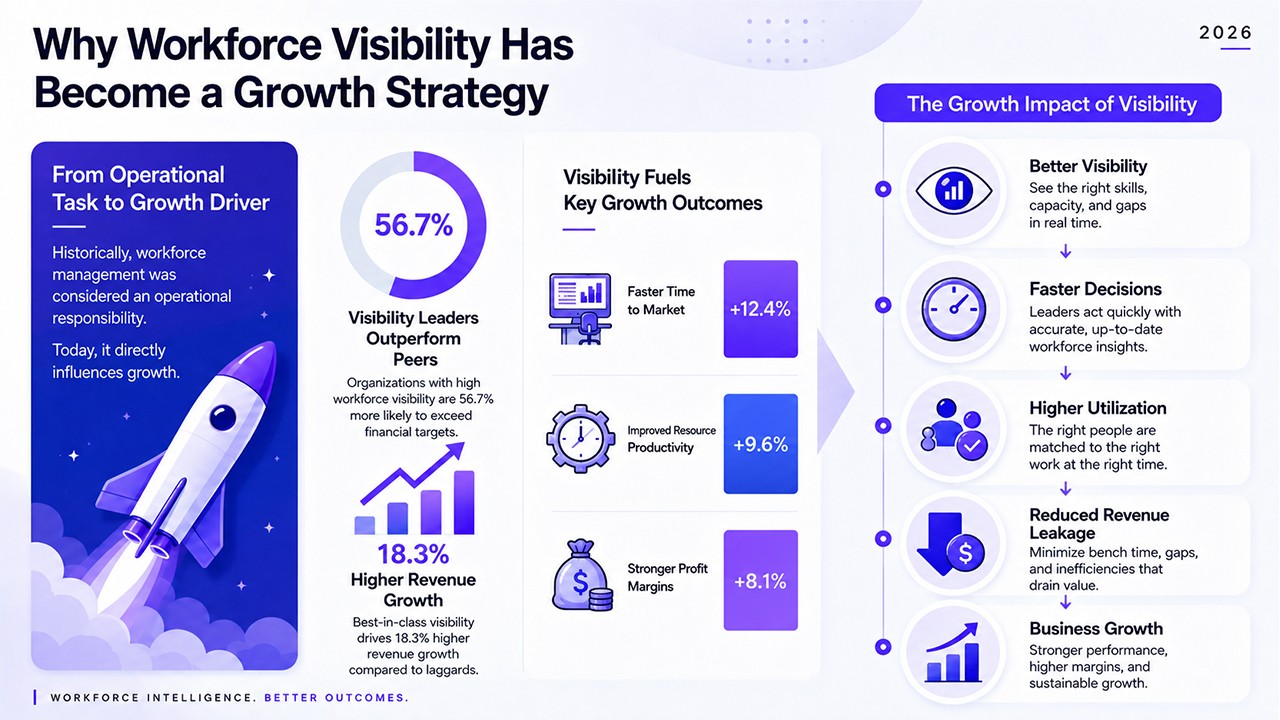
Why Workforce Visibility Has Become a Growth Strategy
Historically, workforce management was considered an operational responsibility. Today, it directly influences growth.
Organisations with strong workforce visibility can:
The firms that consistently outperform competitors are often the firms that understand their workforce best.
5 Trends Shaping Modern Staffing
As these trends accelerate, workforce visibility becomes increasingly important for maintaining competitiveness.
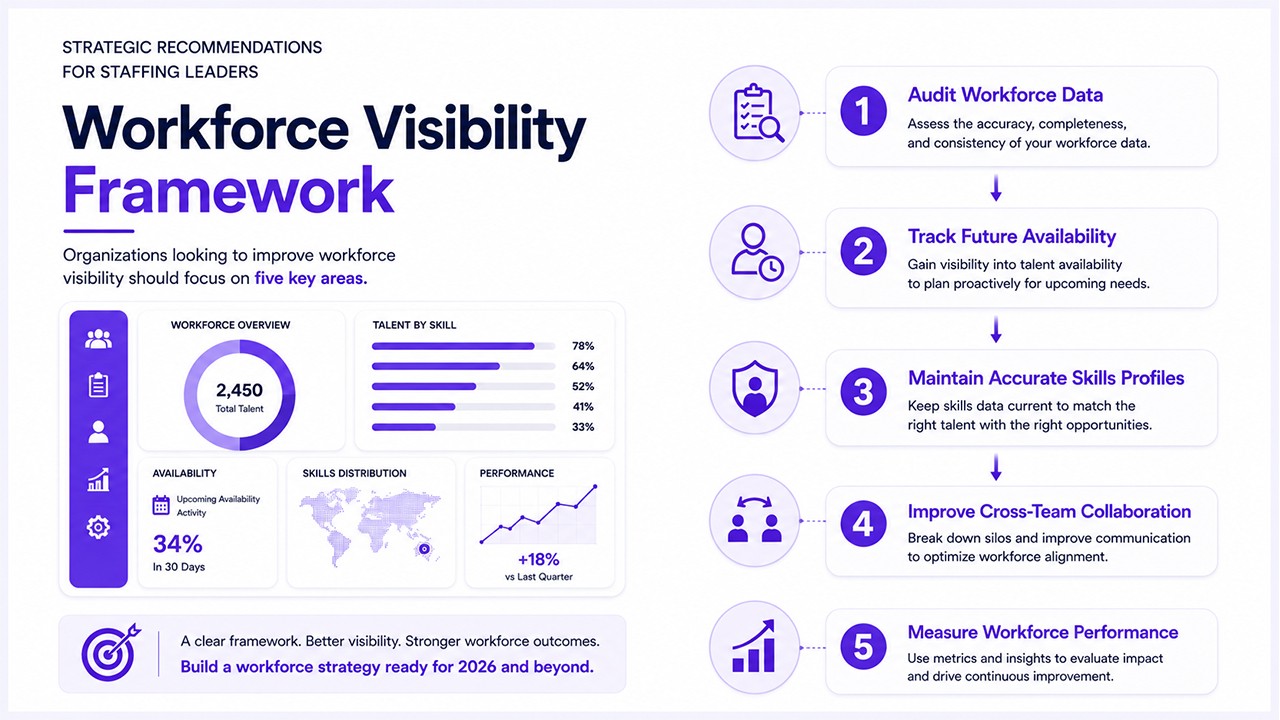
Strategic Recommendations for Staffing Leaders
Organisations looking to improve workforce visibility should focus on key operational metrics and capabilities.
Essential Tracking Metrics
- 01Utilization rates
- 02Deployment speed
- 03Future availability
- 04Workforce capacity
- 05Skills demand trends
Organisations that treat workforce visibility as a business capability rather than an operational process will be better positioned for long-term growth.
Conclusion
The staffing industry has always managed consultant availability. What has changed is the speed, complexity, and competitiveness of today's market.
Traditional bench management answers one question: "Who is available?"
Modern staffing firms require much deeper insight.
They need visibility into workforce skills, future availability, deployment opportunities, utilisation risks, and business demand.
The organisations that achieve this visibility can reduce revenue leakage, improve utilisation, respond faster to clients, and make better business decisions.
The future of workforce management is not about managing the bench. It is about understanding the workforce.
And for staffing firms focused on sustainable growth, workforce visibility may become one of the most valuable competitive advantages of the coming decade.
Continue the Conversation
The firms that consistently improve utilisation are the ones that can identify opportunities before bench time begins.
Explore Workforce Insights for practical guidance on workforce visibility, utilisation optimisation, staffing operations, talent deployment strategies, and the future of workforce management.
About BenMyL
BenMyL helps staffing organisations improve workforce visibility, utilisation, and talent deployment through modern workforce intelligence solutions designed specifically for today's staffing industry.
BenMyl Intelligence
Providing modern workforce intelligence solutions designed specifically for today's staffing industry. We help organisations improve visibility, utilisation, and talent deployment.